- AD150
- Posts
- 70–85% Open Rates, 47% Digital Spend, 50% Webinars: What’s Working Now
70–85% Open Rates, 47% Digital Spend, 50% Webinars: What’s Working Now
Headlines with capital at risk drive 70–85% open rates and webinars lead B2B formats, while telecom shifts 47% of spend to digital.

Good morning, ! This week we’re tracking what drives B2B performance in 2026—capital in motion, format discipline, and credibility at discovery. Headlines tied to real dollars are delivering 70–85%+ open rates, while generic outlooks lag. As nearly half of ad budgets shift digital-first, formats like webinars, paid media, and short-form video are winning by building trust when intent is highest. The takeaway: precision beats volume.
Reach 75,000+ Insurance Executives & Innovators.
Insurance150 connects your brand with carrier leaders, brokers, MGAs, reinsurers, and insurtech operators shaping underwriting, distribution, claims, and risk—placing your message alongside the insights they trust to drive strategy and transformation.
Join 50+ advertisers who reach our 400,000 executives: Start Here.
Know another marketer who’d love this? Pass it along—they’ll thank you later! Here’s the link.
AUDIENCE DATA DIVE
The Headlines Driving 80%+ Open Rates in Private Equity
PE dealmakers are clicking at unprecedented rates — and the winners aren’t guesswork. Subject lines tied to $700B NAV surges, $8B space bets, and $1T sector plays are pulling in 70–85%+ open rates, crushing the norm. The secret? Big numbers, concrete assets, and urgency. Meanwhile, broad outlooks and generic themes slump to the 20–30% range. The message is clear: if it’s not capital in motion, it’s not moving readers. (More)
AD INTEL
Telecom’s Big Shift to Digital Leads the Charge
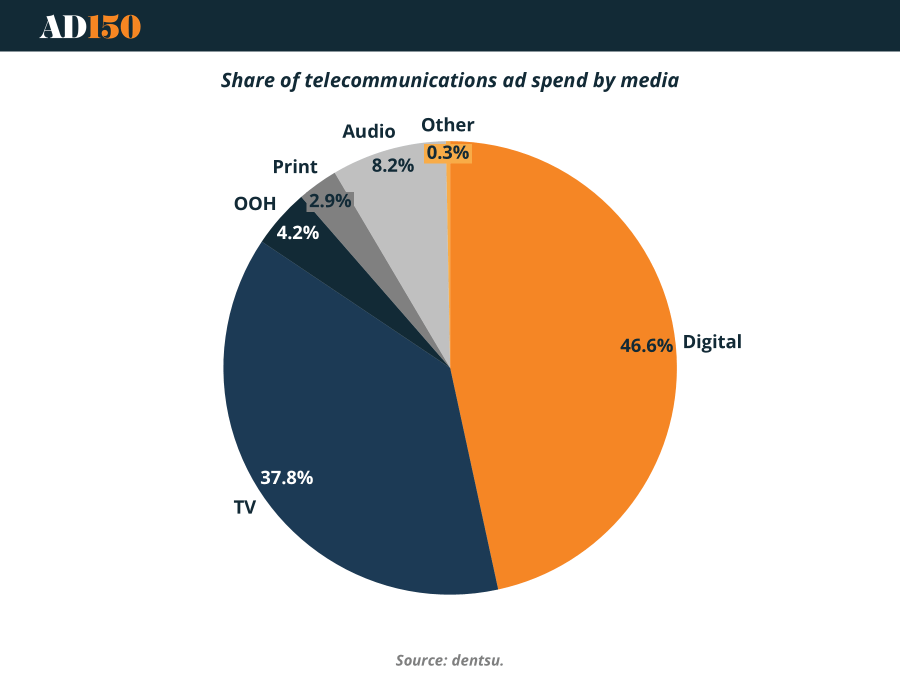
Telecommunications advertisers are going all-in on digital. According to the latest ad spend breakdown, nearly 47% of telecom budgets now flow into digital media—outpacing TV for the first time, which holds ~38%. Audio (8.2%) remains modest but meaningful, while Out-of-Home (OOH), Print, and “Other” formats lag well behind at 4.2%, 2.9%, and under 1%, respectively.
This trend mirrors broader global patterns. According to Dentsu’s 2025 forecast, telecom is among the fastest-growing sectors, with ad spend rising ~8.3%. Digital formats continue to gain share as advertisers shift away from traditional TV, especially linear formats.
Also, IAB reports show digital video—including CTV, social, and online video—has been eating into linear TV’s slice for years.
What this means for media planners: if you’re targeting telecom or similar verticals, expect that digital-first channels deliver both reach and flexibility. TV still matters—especially for branding and mass reach—but digital is where the growth, performance, and innovation are concentrated. (More)
PUBLISHER SPOTLIGHT
Reach 75,000+ Insurance Executives & Innovators
Insurance150 is where carrier leaders, brokers, MGAs, reinsurers, and insurtech operators stay ahead of the forces reshaping underwriting, distribution, claims, and risk. Each issue reaches the executives driving strategy and transformation across the industry—placing your company alongside the insights they rely on to modernize operations, launch new products, and navigate a fast-changing market.
We work closely with partners to structure campaigns that fit their goals, from awareness to demand generation. Our team supports campaign strategy, messaging, and creative development to ensure your placement feels native, credible, and effective within the Insurance150 format.
THE FUNNEL REPORT
When B2B Webinars Win: Timing Matters More Than Ever
Webinars remain a core B2B demand engine—but when you host them is increasingly part of the performance equation.
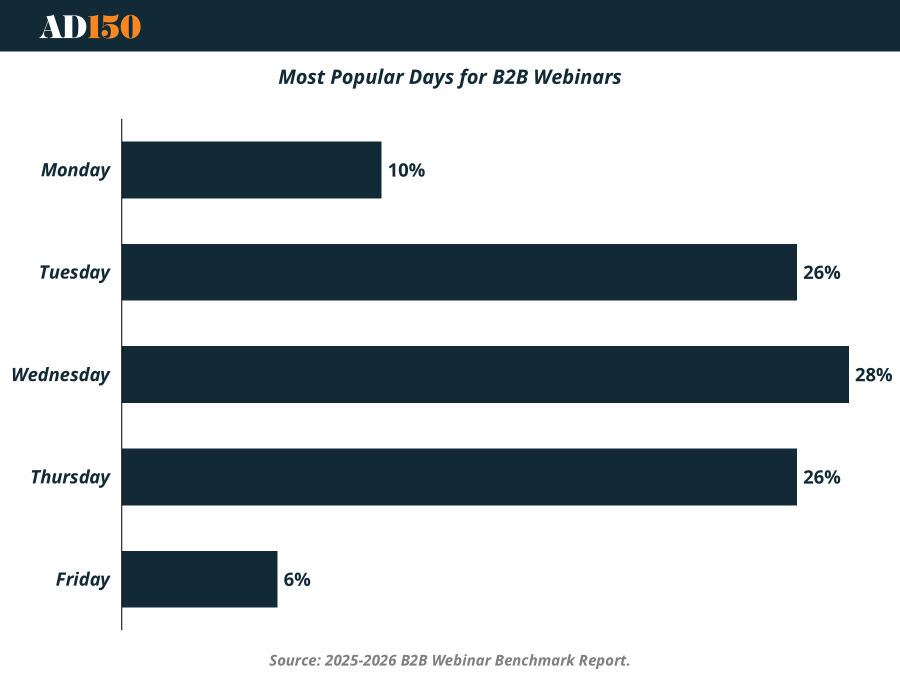
New data from BigMarker shows that Tuesday, Wednesday, and Thursday now account for 80% of all B2B webinars, with Wednesday leading at 28%, followed closely by Tuesday and Thursday at 26% each. While mid-week still dominates, the gap is narrowing. Monday (10%) and Friday (6%) are seeing renewed adoption, signaling that audiences are more open to engaging outside traditional peak days than in prior years.
High-performing teams are leaning into this shift—using calendar strategy as a lever to improve registration and attendance rates, not just volume. The takeaway: mid-week remains safest, but smart marketers are testing edges of the week to stand out in increasingly crowded webinar calendars.
Bold takeaway: Webinar performance isn’t just about content—it’s about timing. (More)
BUDGET SHIFTS
The Technology-First Marketing Organization Is No Longer Optional
By 2026, marketing technology is projected to consume 30% of total marketing budgets, up from 26% today—a clear signal that organizations are moving from experimentation to full-scale, tech-enabled operations.
This shift isn’t about shiny tools. It reflects growing confidence that automation, advanced analytics, and AI-driven platforms can deliver measurable ROI improvements—results early adopters are already seeing. Today’s spend represents a transition phase; the next wave will favor deeper, more embedded technology investments.
However, increased spend introduces new challenges. Integration complexity is quickly becoming the limiting factor. As tech stacks expand, high-performing teams are prioritizing seamless data flows, unified customer views, and stronger data architecture. In the next phase of marketing maturity, execution—not access to tools—will define the winners.
BUYER’S ROOM
What Sales Really Wants From Marketing (And It’s Not More Leads)
When sales teams talk about “marketing support,” they’re not asking for more volume—they’re asking for better conversations.
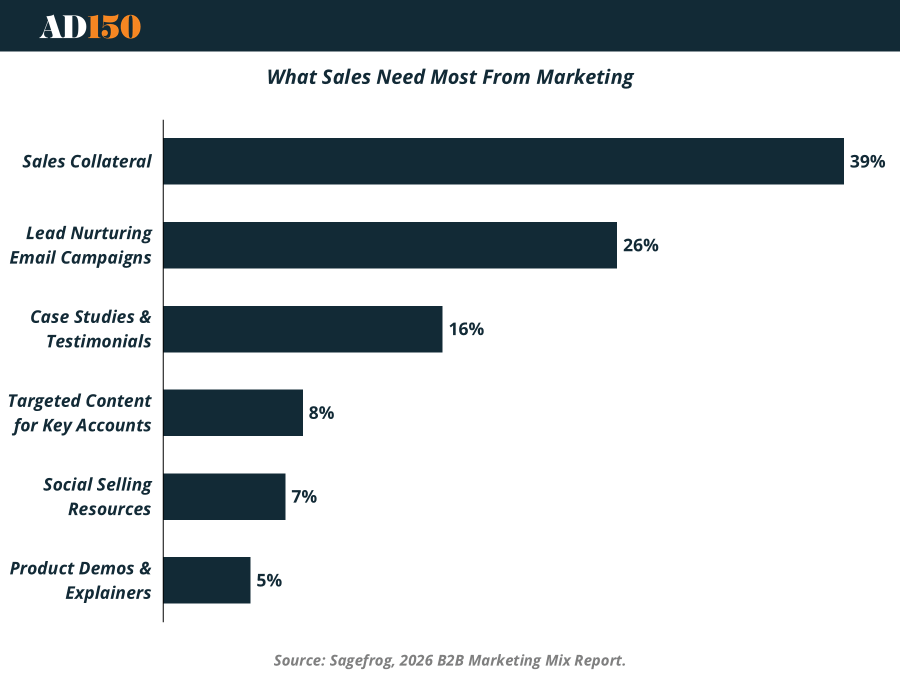
New data shows sales collateral leads the list at 39%, making it the single most valuable contribution marketing provides. Close behind are lead nurturing email campaigns (26%), reinforcing that sales teams rely on marketing to warm accounts before a rep ever enters the deal. Case studies and testimonials (16%) round out the top tier, highlighting the importance of proof over promotion.
Lower on the list are targeted account content (8%), social selling resources (7%), and product demos (5%)—useful, but secondary to assets that directly support deal progression.
The signal is clear: high-performing sales orgs want marketing focused on enablement, credibility, and momentum, not just top-of-funnel activity. (More)
CREATIVE THAT CONVERTS
The Formats Driving B2B Thought Leadership in 2026
In B2B marketing, format choice is no longer a creative afterthought—it’s a performance lever.
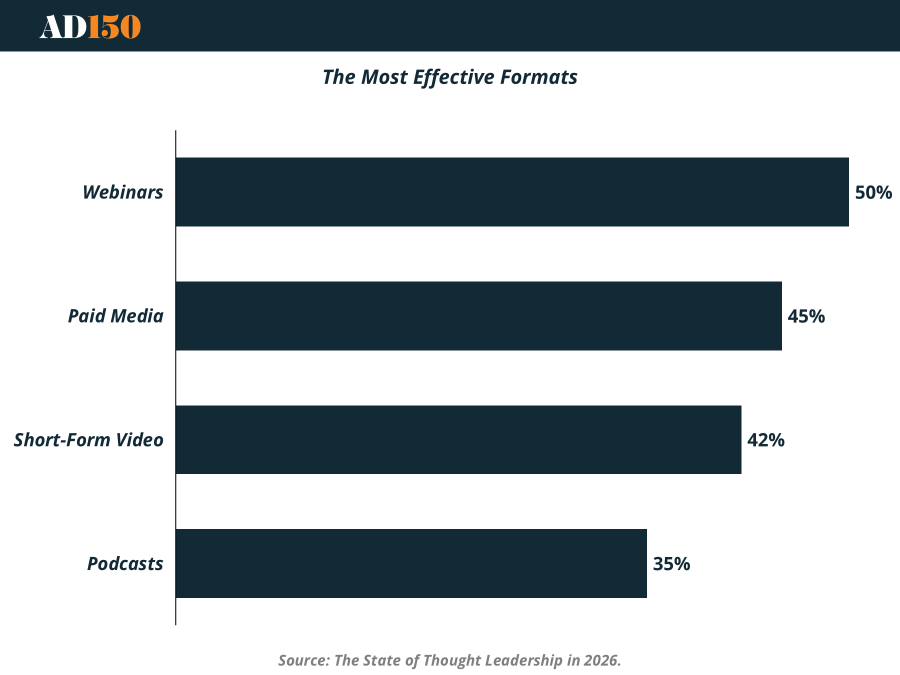
According to new data, webinars remain the most effective format, with 50% of marketers ranking them as top performers. Their strength lies in depth and credibility, especially for complex buying decisions. Paid media follows at 45%, reinforcing the role of distribution in making thought leadership discoverable. Meanwhile, short-form video (42%) continues its climb, driven by executive consumption habits and platform-native engagement.
Podcasts (35%) round out the list, offering durability and intimacy, but requiring longer-term commitment to scale impact.
The takeaway is balance. High-performing teams are not choosing one format—they’re sequencing them, using video and paid media to spark interest, and webinars or podcasts to convert attention into trust. (More)
CASE STUDY
How QuickBooks Reached the Next Generation of Entrepreneurs
As a new wave of small business owners emerged post-pandemic, QuickBooks set out to connect with “Early Starts”—Millennial and Gen Z entrepreneurs launching businesses earlier, but often without formal operational support.
The campaign focused on the “Bizpiphany” moment: the realization that running a business requires more than confidence. Instead of leading with product features, QuickBooks leaned into the emotional tension new founders feel—excitement paired with uncertainty. The brand deployed 300+ digital-first assets, including short-form video, mapped across the customer journey and distributed through paid social, display, native, and owned channels.
The approach paid off. Top-performing videos generated 200,000+ views in the first month, while overall traffic increased 20% year over year, signaling strong resonance with the target audience.
The takeaway: B2B brands win younger buyers by humanizing complexity—using relatable storytelling to earn attention before asking for commitment. (More)



PUBLISHER PODCAST
No Off Button: The "Karmic Banker" theory of business

Champions don’t step away—they keep building. No Off Button is where Aram sits down with founders, operators, and creators who never needed an off switch to create real value. No startup mythology. Just the people who compound through discipline, relationships, and execution.
This week’s guest is Greg Topalian, Chairman of Clarion Events North America and founder of LeftField Media. Greg built New York Comic Con—the largest pop culture event in North America—without ever quitting his job. An intrapreneur by design, he scaled passion-driven communities inside large institutions, managed a $100M+ events portfolio, and learned the business fundamentals the hard way—selling food off a Sysco truck.
The conversation dives into intrapreneurship, enthusiast markets, and Greg’s “Karmic Banker” philosophy: the best operators give first, build relationships early, and let value compound over time.
Why it matters: this is a reminder that long-term wins come from operational grit, leverage, and human connection—not flashy exits.
"It is not the strength of the body that counts, but the strength of the spirit."
J.R.R. Tolkien