- AD150
- Posts
- 70%+ Open Rates, 67% Budget Pressure: Inside B2B Marketing ROI
70%+ Open Rates, 67% Budget Pressure: Inside B2B Marketing ROI
This week we’re tracking how B2B performance is being driven by focus and numbers—from capital- and urgency-led subject lines delivering 75%+ open rates, to marketers reallocating tighter budgets toward what converts.

Good morning, ! This week we’re tracking how B2B marketing performance is being shaped by $-driven insight and measurable impact—from commerce and loyalty content hitting 53% open rates, to email where only 23% surpass 5% CTR. We break down event funnel gaps, why travel media is becoming a $2B+ channel, and how 79% of marketers now use AI for creative—with human guardrails driving results. The signal: specificity wins.
For brands looking to reach consumer and retail leaders directly, Consumer150 connects you with 73,000+ decision-makers across retail, ecommerce, DTC, and consumer tech.
Join 50+ advertisers who reach our 400,000 executives: Start Here.
Know another marketer who’d love this? Pass it along—they’ll thank you later! Here’s the link.
AUDIENCE DATA DIVE
What do retail and consumer marketers actually open?
Our latest Consumer Newsletter analysis reveals a highly engaged audience of B2B marketing and growth leaders drawn to stories that turn market signals into action. Posts focused on e-commerce, loyalty, and digital transformation led performance, with open rates north of 50%, especially when headlines featured clear dollar figures and recognizable brands. Consumer behavior content also stood out when it translated shifts in spending, value, and intent into practical marketing insight.
The pattern is clear: this audience clicks when content helps them plan budgets, refine messaging, and spot what’s scaling next. Numbers, brands, and real-world implications matter. (More)
AD INTEL
Where Email Performance Actually Lands

Email remains one of B2B’s most reliable performance channels—but results vary widely. According to the latest benchmarks, 39% of companies report click-through rates between 3–5%, while 30% fall into the 1–3% range. Only 23% exceed 5% CTRs, underscoring how difficult it is to break into top-tier performance.
The data reveals clear structural advantages. 62% of companies using AI-powered analytics achieve CTRs of 3–5%, compared to just 52% among those that don’t, highlighting AI’s growing role in optimization. Scale also matters: 28% of enterprise companies report CTRs above 5%, outperforming mid-market and SMB peers.
Regionally, APAC leads, with 29% of firms hitting 5%+ CTRs, edging out EMEA and North America. By industry, professional services (30%) and ecommerce (27%) top the list.
The takeaway: strong email performance isn’t accidental—it’s driven by tooling, investment, and execution discipline. (More)
PUBLISHER SPOTLIGHT
Reach 73,000+ Consumer & Retail Decision-Makers
Consumer150 is where consumer brands, operators, investors, and advisors stay ahead of the trends shaping modern commerce. Each issue reaches the executives driving strategy across retail, ecommerce, DTC, consumer technology, and PE-backed consumer brands—placing your company alongside the insights they rely on to scale growth, optimize operations, and build enduring brands.
We work closely with partners to structure campaigns that fit their goals, from awareness to demand generation. Our team supports campaign strategy, messaging, and creative development to ensure your placement feels native, compelling, and effective within the Consumer150 format.

THE FUNNEL REPORT
Where Event Marketing Breaks Down

Event marketing remains a cornerstone of B2B demand generation—but execution gaps persist across the funnel. Our survey shows 52% of marketers struggle to create impactful event experiences, highlighting the growing challenge of standing out in an increasingly crowded event landscape. Differentiation isn’t just a creative issue—it directly impacts downstream engagement and lead quality.
Measurement is the next major friction point. 50% cite determining event ROI as a top challenge, underscoring how difficult it remains to connect in-person or hybrid interactions to pipeline and revenue. Without clear attribution, events risk being viewed as cost centers rather than growth drivers.
The post-event handoff is another weak link. 38% struggle with coordinating follow-up with sales, a breakdown that often results in warm leads going cold. Meanwhile, pre-event awareness (32%) and post-event marketing to extend the event lifecycle (29%) remain underutilized levers.
The takeaway: winning event strategies aren’t isolated moments—they’re full-funnel systems, tightly connected from promotion to pipeline. (More)
BUDGET SHIFTS
Travel Media Quietly Becomes a $2B+ Ad Channel
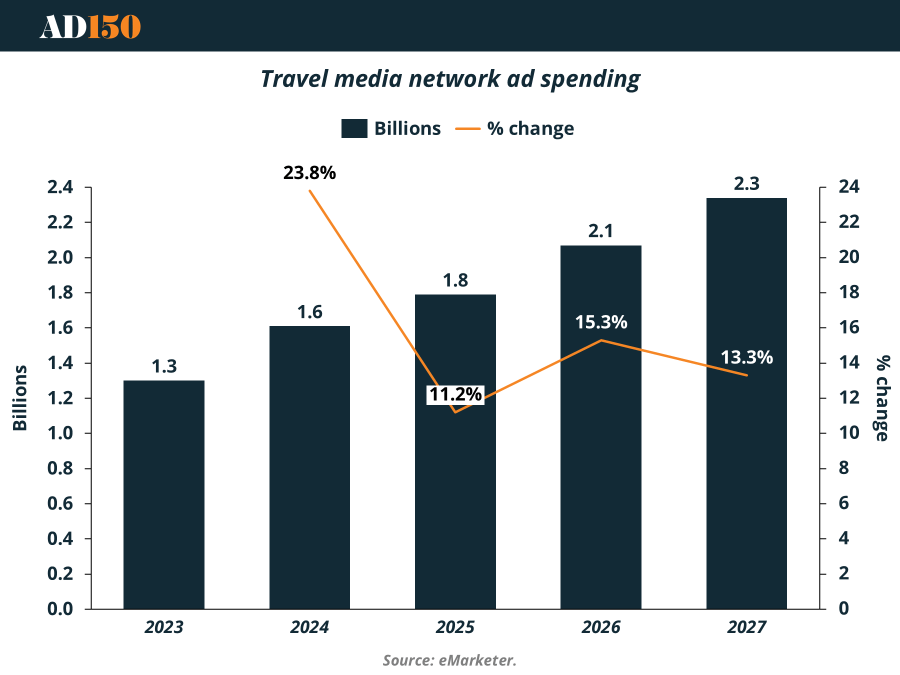
Travel media is crossing a meaningful threshold. According to eMarketer, ad spend across travel media networks will surpass $2 billion in 2026, growing from $1.30 billion in 2023 to $2.34 billion by 2027. While growth cools from a 23.8% surge in 2024, it remains solidly double-digit through the forecast period.
What’s driving the shift isn’t just recovery—it’s structure. Airlines, hotel groups, OTAs, and rideshare platforms now offer scaled, privacy-safe first-party data tied directly to high-intent moments. For advertisers under pressure to prove ROI, travel media increasingly resembles retail media’s playbook: addressable audiences, deterministic signals, and closed-loop measurement.
For B2B marketers, the signal matters beyond travel. This is another example of budgets moving away from broad awareness buys toward owned demand environments where attention, intent, and data converge. As more verticals productize their data, media dollars are following—quietly but decisively. (More)
BUYER’S ROOM
AI is stronger with guardrails
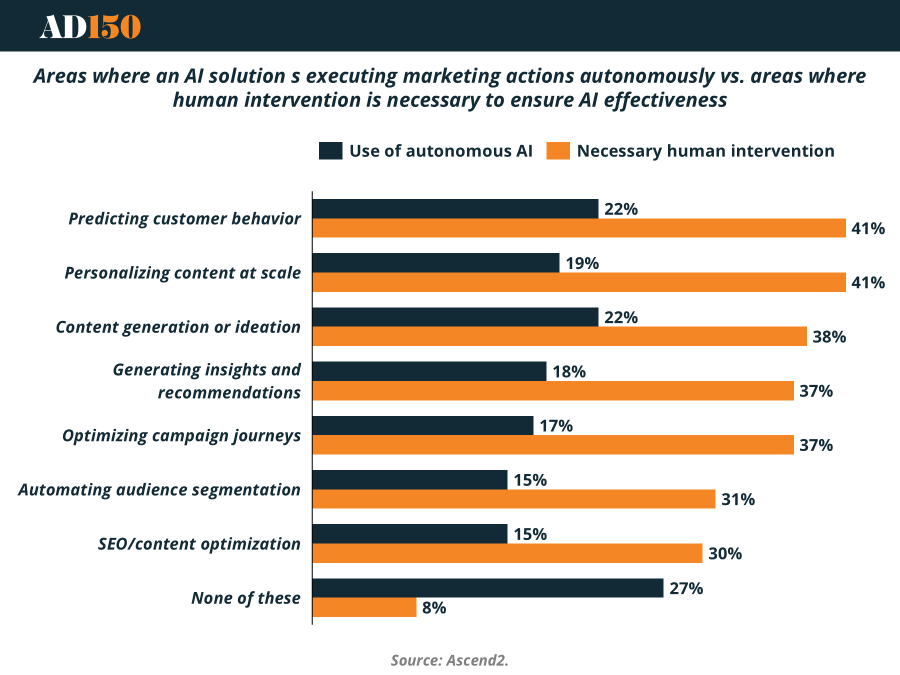
Marketers are eager to harness AI’s promise, but the data is clear: 86% say human intervention is essential to making AI effective. Even in the most advanced use cases—whether that’s predicting customer behavior, personalizing content, or ideating new campaigns—marketers overwhelmingly believe that AI cannot run alone.
The chart highlights this reality. For personalization at scale, only 19% trust AI to act autonomously, compared to 41% who require human oversight. The same gap exists in content generation (22% AI autonomous, 38% human involvement) and insights/recommendations (18% AI, 37% human). The message: while technology can accelerate decision-making and surface hidden patterns, human context is non-negotiable for brand voice, business alignment, and course correction.
For buyers, this marks a crucial inflection point. AI is now a must-have to compete—but organizations recognize that success stems from a hybrid approach. Machines handle the heavy lift, but it’s the marketer’s expertise—the ability to interpret, guide, and infuse purpose into every action—that ensures AI drives results, not just activity. In today’s landscape, the best marketers aren’t ceding judgment to algorithms. They’re building guardrails, ensuring AI-powered strategies never lose sight of what matters: context, brand integrity, and measurable impact. (More)
CREATIVE THAT CONVERTS
Where B2B Marketers Apply AI

AI is no longer a future-state experiment in B2B marketing—it’s already embedded in day-to-day creative execution. Our latest survey shows 79% of marketers apply AI to copywriting, making it the dominant use case. From drafting ad copy to personalizing messaging at scale, AI is becoming a core productivity lever for content teams under pressure to do more with less.
Brainstorming ranks second at 57%, signaling a shift in how creative ideas are generated. Marketers are increasingly using AI as a thought partner—testing angles, iterating faster, and unlocking new campaign concepts earlier in the process.
AI’s role extends beyond words. 43% use it for visual elements, while 37% rely on it as a personal assistant, helping streamline workflows across campaigns. Even strategy (28%) and video production (25%) are seeing meaningful adoption.
The takeaway: high-performing B2B creative isn’t just better—it’s faster, more iterative, and increasingly AI-augmented. (More)
CASE STUDY
How Schneider Electric Turned AI Into a Creative Edge
Schneider Electric’s Unsung Heroes campaign is a sharp example of how B2B marketers can translate data and AI investment into real creative advantage.
The campaign began with a critical realization: Schneider’s digital transformation marketing was missing a key audience—data center decision-makers and influencers. Despite their importance, this group sat outside traditional targeting models and standard content formats.
To close the gap, Schneider used AI to build a more precise ideal customer profile, combining first-party customer data with third-party firmographic, behavioral, and technographic signals. The team also applied psychometric modeling to understand what this audience cared about, not just how they bought.
Those insights fueled more empathetic messaging, sharper visuals, and new content formats beyond whitepapers and eBooks. The campaign rolled out methodically, starting with awareness and moving toward engagement and conversion.
The results were significant: a 39:1 ROI, €71 million in pipeline, and a 77% increase in average opportunity value.
Takeaway: As B2B budgets shift toward data-driven media, AI isn’t just improving efficiency—it’s reshaping creativity itself. (More)


"Do not be embarrassed by your failures, learn from them and start again."
Richard Branson