- AD150
- Posts
- End of Year Special Issue: AI in B2B Marketing — What Actually Mattered in 2025
End of Year Special Issue: AI in B2B Marketing — What Actually Mattered in 2025
Private equity backs 60+ pro teams and European football hits $39B, while the global sports market races toward $1T.


Good morning, ! As we head into the holidays—with Christmas just behind us and New Year’s Eve closing out the year—this special year-end issue looks at how AI actually reshaped marketing behavior this year. From full-stack adoption and content automation to measurement, governance, and AI-driven discovery, we break down what marketers really funded, where the limits showed up, and how it rewrites competitive benchmarks heading into 2026.
Wishing you a happy holidays.
Join 50+ advertisers who reach our 400,000 executives: Start Here.
Know another marketer who’d love this? Pass it along—they’ll thank you later! Here’s the link.
AI in B2B Marketing: What Actually Mattered in 2025
I. AI Adoption Crossed the Point of No Return

In 2025, AI moved from “nice to have” to marketing infrastructure. Nearly half of organizations now allow full AI use in marketing, with most others operating under partial restrictions. What’s notable isn’t just adoption, but the pressure behind it. Marketing teams are being asked to deliver more impact in less time, and AI has become the default response. Budget plans reflect this shift, with most marketing leaders increasing AI and machine learning investment to meet immediate performance demands.

This sense of inevitability is reinforced by competitive fear. A majority of marketers now believe that companies failing to adopt AI will face a significant disadvantage, and a growing share feel strongly about it. While skepticism remains, it’s increasingly outnumbered by pragmatism. The takeaway from 2025 is clear: AI is no longer an experiment — it’s a baseline capability.
II. Where Marketers Actually Put Their AI Budgets
As adoption matured, AI investment became more focused. Rather than chasing futuristic automation, teams doubled down on immediate, measurable payoff. Content creation sits at the center of this shift, with AI embedded in daily workflows.

But usage has expanded well beyond copy, with growing reliance on AI for analytics, targeting, optimization, presentations, and development work — signaling cross-functional adoption.

The motivation behind these investments is efficiency, not novelty. Productivity gains, faster turnaround times, and cost control dominate perceived benefits. In 2025, AI won budget because it removed friction from everyday work. Buyers showed little patience for abstract promises; tools that save time, improve decisions, or scale execution justified their place in the stack.

III. Content at Scale — and the Limits of Automation
While AI solved the problem of volume, it exposed a new one: sameness. As generative tools flooded the market with competent but indistinguishable content, marketers began questioning what was lost. Many now say AI-generated content lacks humanity, with rising concerns around creativity, over-automation, and authenticity. The issue isn’t usability — it’s differentiation.
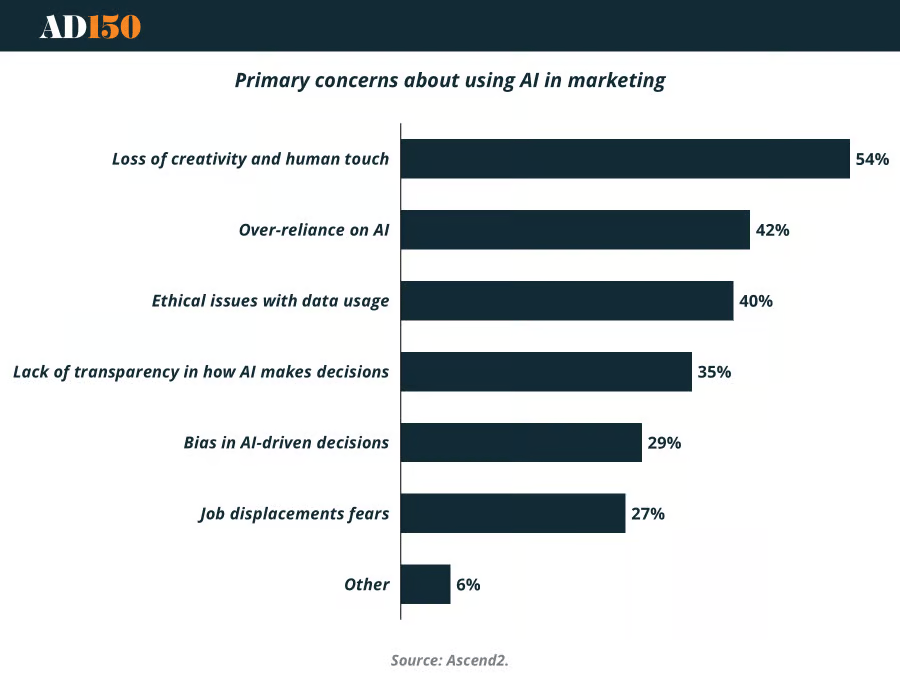
This tension reshaped how teams used AI in practice. Rather than handing over creative control, marketers positioned AI as an accelerator for ideation, structure, and iteration, while reserving voice, judgment, and storytelling for humans. Trust remains fragile, particularly around accuracy, bias, and transparency. In 2025, the best teams didn’t produce more content — they produced more intentional content.
IV. Governance, Privacy, and the Growing Trust Gap
Even as adoption accelerated, governance lagged behind. Many organizations still struggle with unclear policies, skills gaps, and data readiness, leaving marketers unsure not just of what AI can do, but what’s permitted. Privacy and data management concerns remain especially pronounced in B2B environments, where trust and compliance are non-negotiable.

These challenges are less about resistance and more about organizational readiness. Teams want AI — they’re wary of moving faster than their guardrails. Integration issues, ethical questions, and leadership alignment continue to slow deployment, reinforcing a human-in-the-loop model. In 2025, AI maturity was defined not by tool count, but by control and accountability.
V. AI Is Rewriting Discovery and the Top of the Funnel
Beyond internal workflows, AI is reshaping how audiences discover brands. A growing share of consumers now rely on AI tools and agents to find information, compare options, and even make decisions. For marketers, this marks a shift: AI is becoming a front-door channel, not just a backend capability.

Search behavior is already changing, with early movers optimizing for conversational queries and AI-driven discovery rather than keywords alone. At the same time, interest in AI-powered customer service shows how agents are beginning to collapse discovery, decision, and retention into a single experience. Brands that invest in structured data, clarity, and relevance will be easier for AI to recommend — and easier for buyers to trust.
Bottom Line
2025 didn’t deliver an AI marketing revolution — it delivered normalization. AI became expected, embedded, and increasingly invisible. The advantage now lies not in using AI, but in using it with intent: focused on real problems, governed with care, and guided by human judgment.
2026: AI Becomes Non-Optional
I. AI Spend Accelerates — and Concentrates
If 2025 was the year AI became normalized, 2026 will be the year it becomes unavoidable. Adoption of AI and machine learning in marketing is projected to triple by 2028, with nearly half of B2B marketers expected to rely on AI for targeting, personalization, and budget allocation. What’s important here isn’t just the growth rate — it’s the compression of timelines. Capabilities that were once considered advanced experimentation are quickly becoming baseline expectations.

For ad buyers, this has immediate implications. As AI-enabled media tools increasingly define efficiency benchmarks, cost-per-lead and performance standards will rise accordingly. Teams that delay adoption won’t just move slower — they’ll compete at a structural disadvantage. By 2026, AI-driven bidding, testing, and optimization won’t be a differentiator; they’ll be the minimum requirement to stay competitive in B2B paid media.
II. AI Rises to the Top of the 2026 Investment Stack

As AI reshapes discovery, marketers are rethinking what “content investment” actually means. Budgets are increasingly split between Generative Engine Optimization (GEO), AI search visibility, and the tools and technology required to support AI-first content strategies. This marks a notable evolution: content success is no longer measured only by quality or volume, but by how easily AI systems can find, interpret, and recommend it.
At the same time, concerns about short-term performance remain very real. Nearly a third of marketers still prioritize paid content distribution, while others double down on SEO and social distribution to ensure reach doesn’t collapse as algorithms change. The takeaway for 2026 is pragmatic rather than idealistic: AI-native content must still be distributed aggressively. Visibility, not just creation, will define returns.
What This Means for 2026
By 2026, AI will no longer sit alongside marketing strategy — it will shape it. Investment is flowing toward systems that improve efficiency today while preparing teams for an AI-mediated buying journey tomorrow. The winners won’t be those who “use AI,” but those who align tools, data, content, and distribution around how AI increasingly governs attention.
The next phase of B2B marketing won’t reward volume or novelty. It will reward clarity, structure, and adaptability — qualities that both humans and machines respond to.
"Get busy living or get busy dying."
Stephen King