- AD150
- Posts
- Where B2B Budgets Are Actually Moving (55%, 36%, $7M)
Where B2B Budgets Are Actually Moving (55%, 36%, $7M)
C-suite open rates hit 55% and precision channels drive 36% of leads, while Super Bowl spots command $7M despite media fragmentation.

Good morning, ! This week we’re tracking where B2B attention—and budget—are actually moving: the topics C-suite leaders open most (~55%), precision channels now driving 36% of qualified leads, and AI-native platforms already used by 56% of marketers for content discovery. We also break down why $7M Super Bowl spots still clear the market and how AI is reshaping high-performing email creative. The signal: specificity wins—and it scales.
For brands looking to reach consumer and retail leaders directly, Consumer150 connects you with 73,000+ decision-makers across retail, ecommerce, DTC, and consumer tech.
Join 50+ advertisers who reach our 400,000 executives: Start Here.
Know another marketer who’d love this? Pass it along—they’ll thank you later! Here’s the link.
AUDIENCE DATA DIVE
What C-Suite Leaders Open
C-suite readers of our Consumer newsletter show exceptionally strong engagement, consistently opening content tied to money, scale, and disruption.
E-Commerce, Loyalty & Digital Transformation leads performance with ~55% open rates, driven by subject lines featuring $ figures, % shifts, and platform-level change. Consumer Trends & Behavior follows (~42%), resonating most when behavioral shifts are framed as early signals for pricing, media, and demand.
M&A and capital stories deliver steady engagement (~46%), proving executives value strategic context alongside execution insight.
For advertisers: this is a high-attention environment where senior decision-makers engage with data that informs budgets, channels, and growth strategy. (More)
AD INTEL
Qualified Leads Are Moving to Precision Channels
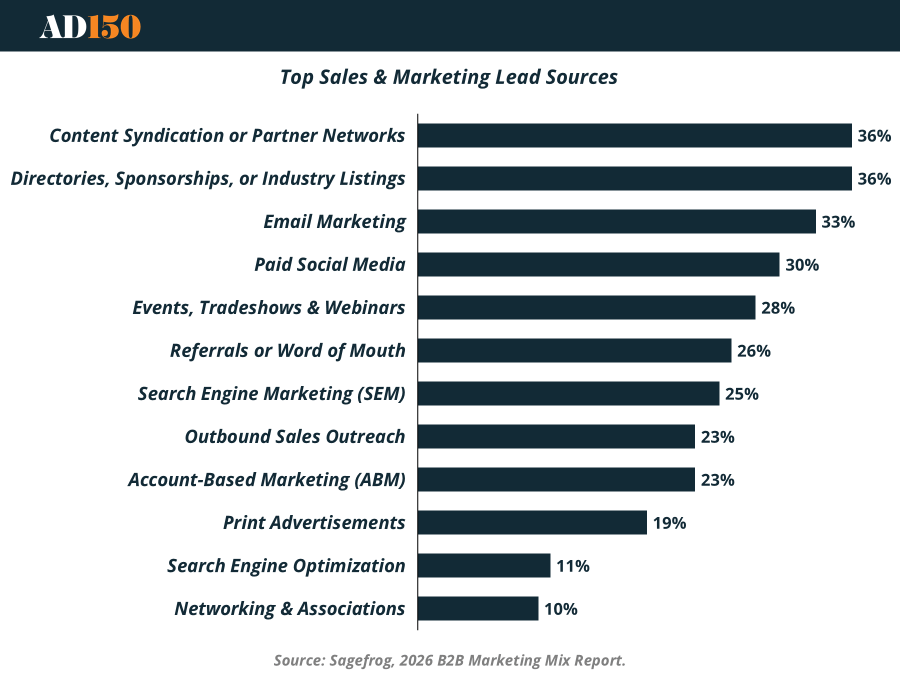
2B lead generation is becoming more targeted—and more digital-first. New data shows that in 2025, the highest-quality leads are no longer dominated by events. Instead, content syndication and partner networks (36%) now tie with directories and sponsorships (36%) as the top sources of qualified leads, signaling a shift toward scalable, intent-driven distribution.
Email marketing (33%) and paid social (30%) continue to deliver strong results, reinforcing their role as reliable mid-funnel engines when paired with strong segmentation and messaging. While events, tradeshows, and webinars (28%) remain important, their relative influence has declined as marketers prioritize channels that offer precision, measurability, and faster feedback loops.
Notably, SEM (25%), ABM (23%), and outbound sales (23%) remain critical for high-intent engagement, underscoring a broader move toward quality over volume.
The takeaway: B2B marketers are reallocating toward channels that connect them with the right buyers—not just more buyers. (More)
PUBLISHER SPOTLIGHT
Reach 73,000+ Consumer & Retail Decision-Makers
Consumer150 is where consumer brands, operators, investors, and advisors stay ahead of the trends shaping modern commerce. Each issue reaches the executives driving strategy across retail, ecommerce, DTC, consumer technology, and PE-backed consumer brands—placing your company alongside the insights they rely on to scale growth, optimize operations, and build enduring brands.
We work closely with partners to structure campaigns that fit their goals, from awareness to demand generation. Our team supports campaign strategy, messaging, and creative development to ensure your placement feels native, compelling, and effective within the Consumer150 format.

THE FUNNEL REPORT
AI-Native Platforms Enter the B2B Distribution Funnel

Content discovery in B2B marketing is no longer confined to search and social. According to 10Fold Research (2025), 65% of marketers still rely on traditional browsers like Google, Microsoft, and Safari as part of their content distribution strategy—but AI-native platforms are quickly closing the gap. ChatGPT, Perplexity, and other AI-first tools are already used by 56% of respondents, signaling a meaningful shift in how buyers discover and evaluate information.
Social platforms continue to play a critical mid-funnel role, with YouTube (47%) leading for educational and long-form content, followed by LinkedIn (42%) for professional validation and demand capture. Meanwhile, forums and industry-specific communities remain niche but influential, especially for late-stage research.
The takeaway for B2B marketers: funnels are becoming multi-surface by default. Winning strategies now optimize not just for search and social—but for AI-assisted discovery, where content quality, structure, and authority increasingly determine visibility. (More)
BUDGET SHIFTS
Super Bowl LX Confirms Brands’ Willingness to Pay for Scarce Attention
As Super Bowl LX approaches on Feb. 8, 2026, one thing is already clear: premium reach still commands premium dollars. NBCUniversal has sold out all ad inventory, with 30-second spots priced around $7 million, underscoring how live tentpole events continue to absorb outsized brand budgets despite broader media fragmentation.
The stakes remain high. Super Bowl 2025 drew 127.7 million U.S. viewers across linear and streaming, making it the most-watched Super Bowl on record—and reinforcing the game’s role as one of the few moments that still delivers true mass reach. Early advertiser signals point to a familiar mix of brand debuts, returns from legacy advertisers, and proven playbooks like celebrity endorsements and nostalgia. At the same time, marketers are expected to experiment with generative AI–enabled creative as production and personalization tools mature.
The takeaway: even as budgets diversify across digital channels, mega-events remain budget anchors, pulling dollars toward moments where attention is scarce, shared, and culturally unavoidable. (More)
BUYER’S ROOM
Everyone Says They Do ABM—Very Few Mean It

Ask most B2B marketers if they’re running ABM, and the answer is yes. Ask how personalized it actually is, and the picture changes fast. While nearly half of ABM programs are still in a developing stage, execution remains largely light-touch.
In practice, 70% of ABM teams rely on basic firmographics, and 65% personalize by role or title—useful, but table stakes. Only 40% create account-specific content, and just 33% tailor messaging to where buyers actually are in the journey. Behavioral signals? Still underused. AI-driven personalization barely registers at 2%.
From a buyer’s perspective, this shows up clearly. “ABM” often feels like slightly better targeting, not true one-to-one relevance. The emails are recognizable. The ads are familiar. The intent isn’t wrong—but the execution falls short.
The opportunity is clear: buyers don’t need more ABM. They need smarter ABM—rooted in behavior, timing, and real signals, not just firmographic labels. (More)
CREATIVE THAT CONVERTS
AI Is Reshaping What “Good” Email Creative Looks Like
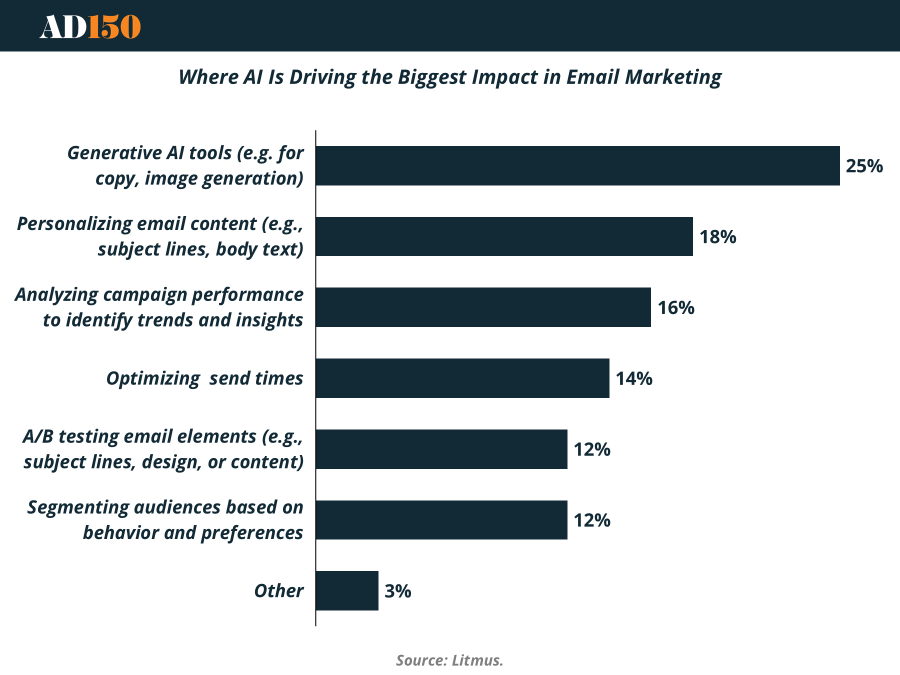
Email creative is getting smarter—and more automated. According to Litmus’ State of Email 2025, Generative AI tools are now the most impactful AI use case in email marketing, cited by 25% of marketers. From subject lines to image generation, AI is accelerating production while improving relevance at scale. In fact, usage of GAI for image generation jumped 340% between 2024 and 2025.
But the gains don’t stop at creation. Personalized email content ranks second (18%), followed by AI-driven performance analysis (16%) that helps teams identify what’s resonating faster. Even classic tactics like send-time optimization (14%) and A/B testing (12%) are being enhanced by AI models that learn and adapt in real time.
The takeaway: high-performing email creative in 2025 isn’t just well-written—it’s adaptive, data-informed, and AI-assisted. Winning teams are using AI not to replace creativity, but to sharpen it and scale what works. (More)
CASE STUDY
w Pinterest Used Action-Movie Storytelling to Reframe B2B Performance Marketing
When Pinterest set out to introduce its Performance+ products to a younger, Gen-Z–leaning B2B audience, it didn’t default to feature lists or product demos. Instead, the brand went cinematic. “P is for Performance” reimagined B2B advertising as a series of six high-energy mini action films, complete with bold characters and a playful narrative that stood out in a category dominated by conservative creative.
The strategy was deliberate. By borrowing from Hollywood-style storytelling, Pinterest aligned the campaign’s tone with the platform’s visual-first, creator-driven identity—while signaling that performance marketing doesn’t have to look boring. The campaign ran across paid social, trade publications, and PR, maximizing both reach and credibility.
The results validated the risk. Pinterest delivered 300M impressions, 115M+ video views, and an 84% video completion rate, well above benchmarks. The effort also drove over 1M clicks to Pinterest Business and produced a 10-point lift in perception of its performance products. (More)



"Our greatest weakness lies in giving up. The most certain way to succeed is always to try just one more time."
Thomas Edison