- AD150
- Posts
- Where B2B spend is shifting: 47% digital, 85% quality leads & $-led headlines
Where B2B spend is shifting: 47% digital, 85% quality leads & $-led headlines
Telecom ad spend hits 47% digital and 85% of marketers prioritize lead quality, while AI is projected to reshape 44% of content creation.

Good morning, ! This week we’re tracking how B2B performance is refocusing on financial relevance and lead quality—from executive audiences responding most to $-driven, risk- and deal-led narratives, to marketers prioritizing sales-ready leads over volume (85% vs. 48%), and AI’s biggest impact shifting toward content creation (44%), not black-box optimization. The signal is clear: specificity, value, and money-in-motion outperform buzz.
For brands looking to reach investors directly, PE150 now connects you with 145,000+ private equity decision-makers, with 50% OFF placements available throughout December.
Join 50+ advertisers who reach our 400,000 executives: Start Here.
Know another marketer who’d love this? Pass it along—they’ll thank you later! Here’s the link.
AUDIENCE DATA DIVE
C-Suite Insurance Readers Love Dollars, Deals, and Risks — Here’s How to Win Their Attention
Senior insurance executives aren’t clicking on buzzwords—they’re chasing tangible value. Our dive into 50+ newsletters and 700K+ impressions shows that headlines tied to dollar figures, untapped markets, or sector-specific risks consistently outperform generic or tech-hype stories. Open rates spike above 80% when executives see content on missed premiums, luxury exposures, or multi-billion-dollar deals. For advertisers, this is gold: placing your message alongside stories of capital in motion, vertical-specific risks, or strategic moves means higher engagement and credibility. Content without clear financial stakes struggles to break through. The takeaway? Align your campaigns with opportunity, specificity, and money-in-motion narratives—and your ads will ride the wave of executive attention. (More)
AD INTEL
Telecom’s Big Shift to Digital Leads the Charge
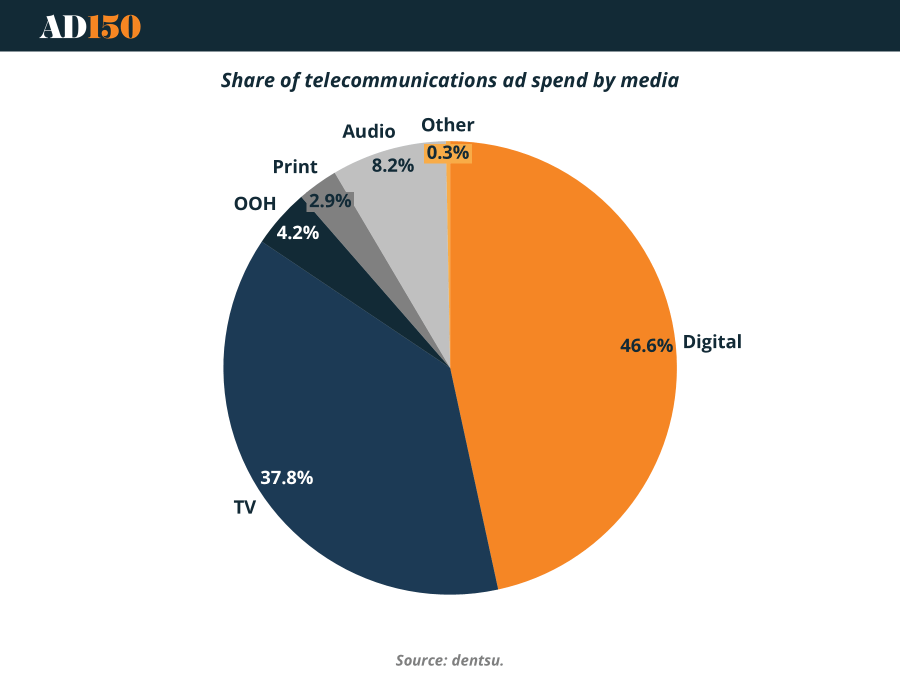
Telecommunications advertisers are going all-in on digital. According to the latest ad spend breakdown, nearly 47% of telecom budgets now flow into digital media—outpacing TV for the first time, which holds ~38%. Audio (8.2%) remains modest but meaningful, while Out-of-Home (OOH), Print, and “Other” formats lag well behind at 4.2%, 2.9%, and under 1%, respectively.
This trend mirrors broader global patterns. According to Dentsu’s 2025 forecast, telecom is among the fastest-growing sectors, with ad spend rising ~8.3%. Digital formats continue to gain share as advertisers shift away from traditional TV, especially linear formats.
Also, IAB reports show digital video—including CTV, social, and online video—has been eating into linear TV’s slice for years.
What this means for media planners: if you’re targeting telecom or similar verticals, expect that digital-first channels deliver both reach and flexibility. TV still matters—especially for branding and mass reach—but digital is where the growth, performance, and innovation are concentrated. (More)
PUBLISHER SPOTLIGHT
Reach 145,000+ Private Equity Decision-Makers at 50% OFF
PE150 is where private equity investors, operating partners, bankers, and corporate development teams stay ahead of the trends shaping dealmaking, value creation, and portfolio performance. Each issue reaches the executives driving strategy across buyout, growth, secondaries, private credit, and PE-backed operators, placing your brand alongside the intelligence they rely on for deployment, exits, and execution.
And throughout December, you can reach this audience with our Black Friday offer: 50% OFF placements, 30% OFF dedicated emails, plus a free primary slot.

THE FUNNEL REPORT
Lead Gen Priorities Have Shifted to Quality Over Volume
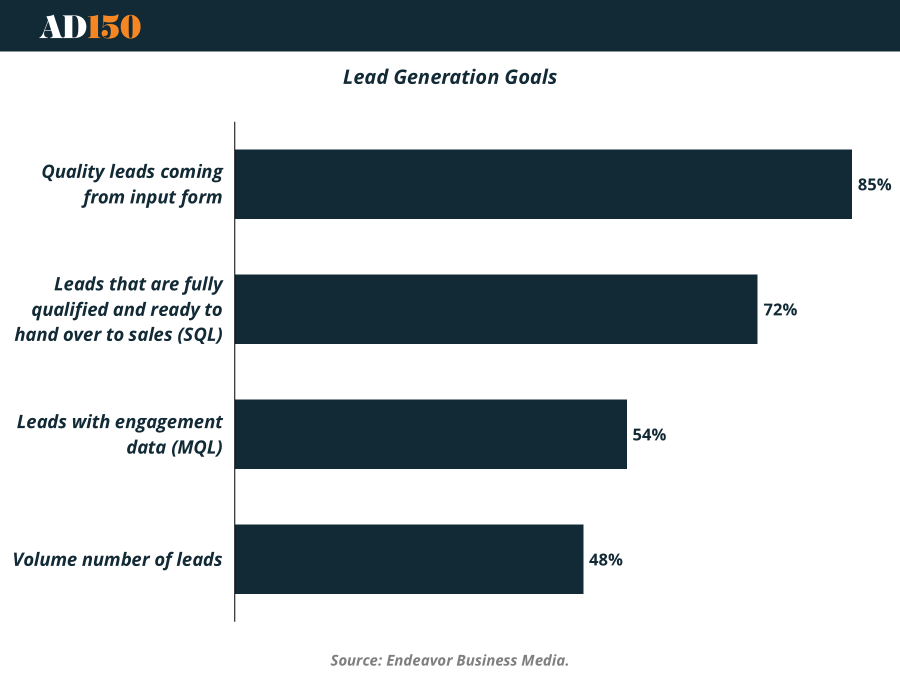
B2B demand teams are done chasing raw volume — the mandate for 2025 is precision, qualification, and sales readiness. According to new survey data, 85% of marketers now rank “quality leads coming from input forms” as their top priority, signaling stricter gating, tighter ICP criteria, and better on-page intent signals.
The pressure to support revenue teams is clear: 72% say generating fully qualified, sales-ready leads (SQLs) is mission-critical. Mid-funnel intelligence also matters, with 54% prioritizing MQLs enriched with engagement data — meaning scoring rules, heat-mapping, and nurture sequencing are becoming minimum viable ops.
And the old success metric? It’s fading. Only 48% still prioritize sheer lead volume. In other words: spray-and-pray is dead — qualified conversion paths win. (More)
BUDGET SHIFTS
Where Marketers Expect AI to Reshape Marketing

When marketers look ahead, AI’s impact is expected to land first—and hardest—on content. 44% say content creation (copy, visuals, video) will be the most transformed area by AI over the next five years, far outpacing every other function. Predictive analytics and forecasting follow at 25%, signaling growing confidence in AI’s ability to guide planning and demand modeling, not just execution.
Interestingly, traditionally hyped use cases like chatbots and automated customer support lag far behind at 9%, tied with marketing strategy and decision-making. Even more telling: only 4% point to paid advertising optimization, and just 2% to campaign performance tracking and ROI measurement.
The takeaway? Budgets may shift less toward “black-box optimization” and more toward AI-powered production and planning leverage. Marketers appear to trust AI to help them create and forecast faster—while keeping tighter human control over spend, optimization, and measurement, at least for now. (More)
BUYER’S ROOM
What B2B Buyers Really Think About Your Gated Content
We asked actual B2B decision-makers what they think of the content behind forms—answers may surprise you: while 60% generally trust what they consume, a staggering 71% admit they’re disappointed in the value that gated content delivers. In short, trust is there—but perceived value is the weak link.
What It Does Well:
Humanizes the buyer experience by highlighting candid feedback
Reveals buyer psychology—what earns their trust isn't enough; content must deliver real value
Guides vendor strategy—content creators should aim to exceed expectations, not just gate traffic
You could optionally contrast this later with content that has impressed buyers—if you have those stories or buyer quotes—doubling the insight. (More)
CREATIVE THAT CONVERTS
B2B Email Open Rates, Benchmarked

Most B2B marketers are still fighting for attention in the inbox—and the data shows how narrow the window for “above average” performance really is. According to the latest benchmark data, 33% of companies report email open rates between 20–30%, making it the most common outcome across company sizes. Another 27% land in the 10–20% range, while just 17% break into the 30–40% tier. Only 8% of marketers see open rates above 40%, underscoring how rare truly standout email performance is.
What separates the winners? Frequency and focus. Companies emailing weekly or daily are more likely to outperform those sending biweekly or less, and teams allocating 15%+ of their marketing budget to email are twice as likely to exceed 40% opens. The takeaway: inbox success isn’t just about clever subject lines—it’s about commitment, consistency, and treating email as a core growth channel, not an afterthought. (More)
CASE STUDY
GfK’s “Human vs. AI” Puts Thought Leadership on Center Stage
German market research firm GfK proved that B2B brand lift doesn’t come from touting features — it comes from owning the hottest conversation in the market. Rather than pushing AI-powered tools, GfK launched a provocative awareness play: a video debate between its CMO, Gonzalo Garcia, and a ChatGPT-powered avatar named Ruby. The premise was simple: can AI out-market a human executive?
The execution sparked curiosity, humor, and credibility. The debate positioned GfK inside a cultural flashpoint — AI’s role in marketing judgment — and did it without gimmicks. To amplify reach, the team leaned heavily on influencer distribution, turning a single creative asset into industry conversation.
The payoff was unmistakable: 7M impressions (beating projections by +2M), an 8/10 LinkedIn quality score, and deeper B2B engagement driven by influencer amplification.
The lesson: smart “newsjacking” works when the brand enters the dialogue with a real point of view — not a sales pitch.(More)


"Get busy living or get busy dying."
Stephen King